I have probably mentioned it before, but I will do it again. I need some kind of a introductory sentence to this post 😉 The dream garden for us is a naturalistic and effortless garden, that encourages wildlife and preserves it. And we think there should be place to three elements in it: the kitchen garden, ‘meadows’, and the flower boarders. I will talk about our ‘meadows’ in another post and keep this one just about flower boarders.
Mr. J. and me, we are totally in love with Piet Oudolf. We love his gardening way and his gardens. His gardens are amazing, and we, much inspired by Piets dream plants, purchased both some seeds and tiny roots to create the flower boarders from scratch. It’s lots of work to start with seeds. BUT the whole process was just such an absolute joy. We were excited about what our efforts would bring and it was tremendously satisfying when we finally could see the results. And it is reasonable from the economical perspective as well. We want to experiment and over the years will need hundreds of plants. So the low cost on seeds gives us a bigger space for experimentation and of course learning.
So we were on internet and physical stores to find seeds of the plants we adore. And we gave it a try in March (2019). Some of the seeds didn’t really make it, and some of them did make their way up. I guess that is how it is. And we are satisfied with the results. So much satisfied, that we are going to continue with the experiment next year as well. So much looking forward to it. For a couple of days ago we thought that the seedlings which made their way up should come outside in real soil. We placed them in two flower boarders.
‘West side house’ flower boarder
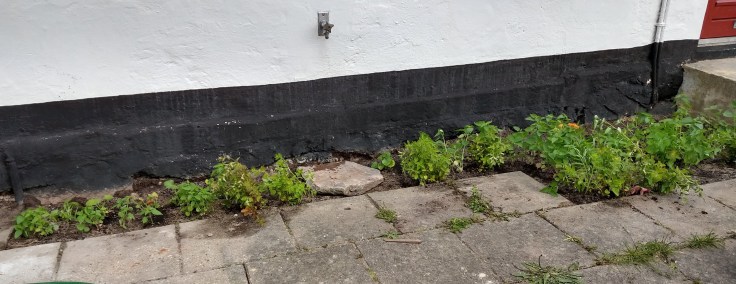 We have this concrete tile courtyard just in front of the house when looking from West. Such a practical feature. You don’t bring mud into the house. Children can skate and bike on tiles, and so on. But it is too big and lucks…ummm…life? It is like, how you would describe it, too concrete-ish, too dull. The long term plan is to replace concrete tiles with some natural stones and make the space more lively with some flower boarders. Mr. J. dreams about a courtyard with Ölandssten natural stones. It is a limestone from Sweden that has this wonderful redish tones in it. And I understand that. But it is a quite a big project to redo the courtyard at once, so we decided to divide the work into butches and start with the easiest part. And that is, establishing some flower boarders. We thought taking up some tiles to introduce flower boarders there instead will automatically reduce the number of tiles. Smart, right?
So, since the first boarder was going to be right in front of the house, the design of the boarder was very obvious – the tallest plants in back of the boarder and shorter ones in front. We were able to germinate lots of agastache foeniculum and hollyhocks, so we happily planted them. Salvia nemorosa was sowed directly in the boarder. We also had loads of verbena seedlings, so some of them were placed next to the hollyhocks. To keep the boarder interesting during the spring as well we plan to plant some bulbs here. I will update the below list as soon as we get it done.
List of plants in ‘West side house’ boarder:
| Name | Soil | Light | Height | Blooming | Structural interest | Notes |
| Oreganum | Dry | Sun | 50 cm | MS-EF | 3-6 months | |
| Agastache foeniculum | Dry | Sun | 100 cm | MS-EF | 3-6 months | |
| Salvia nemorosa | Dry | Sun | 40-90 cm | MS-EF | 6-9 months | |
| Asclepias tuberosa | Dry | Sun | 60 cm | MS-LS | 3-9 months | |
| Alcea | Dry | Sun | 1800 cm | MS-LS | 6 months | |
| Verbena bonariensis | Dry | Sun | 1500 cm | MS-LS | 3-6 months |
‘Southern mid’ flower boarder
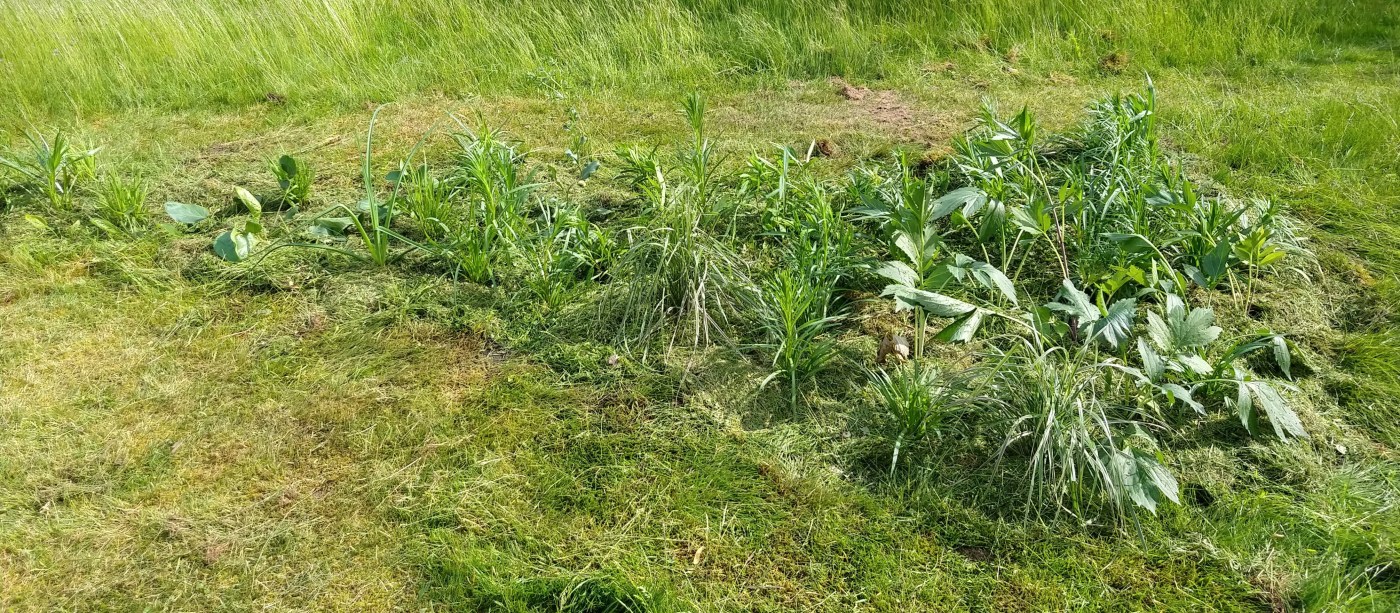
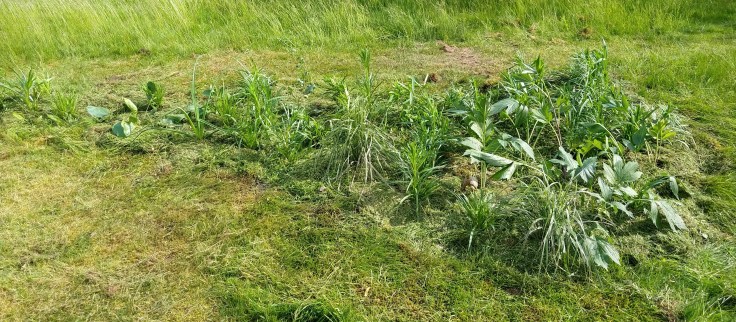 We created a boarder right in the loan. Mr. J. removed the upper part of the grass loan and planted the seedlings we germinated. Why start a new boarder in the middle of the loan in stead of refreshing the old boarders? Well, it is so much easier to design a new boarder compared to re-designing the old ones.
In this boarder, liatris is the dominating plant. And two types of grasses are incorporated here. We failed germinating calamagrostis acutiflora ‘Karl Foerster’. But since I really wanted some grass here, we had to drop by the local nursery and purchase some. Bulbs will be here as well. Next spring. We didn’t really decide yet what kind besides some allium. We will see.
Plants in ‘Southern mid’ boarder:
| Name | Soil | Light | Height | Blooming | Interest | Notes |
| Liatris spicata | Normal | Sun | 100 cm | MS-LS | 3-9 months | |
| Aster | Fertile | Sun/half shade | 60 cm | LS–F | 3-9 months | |
| Rudbekia nitida ‘Herbstsonne’ | Normal | Sun | 200 cm | LS-F | 3-9 months | |
| Eryngium planum | Normal | Sun | 90 cm | ES-LS | 3-9 months | |
| Echinacea purpurea | Fertile | Sun | 100 cm | MS-F | 9 months | |
| Kniophofia uvaria | Normal | Sun | 100 cm | MS-F | 3-9 months | |
| Verbena bonariensis | Dry | Sun | 1500 cm | MS-LS | 3-6 months | |
| Molina caerulea | Any but not too dry | Sun/half shade | 50-80 cm | F-EW | 8-9 months | Fits anywhere. Good fall color |
| Calamagrostis acutifolia | Any | Sun/half shade | 130 cm | ES-W | 8-9 months | Winter interest |
Key to list
Highlighted:
Yellow – annual
Purple – biennial and short lived
Green – grass
Blue – bulbs
MS – midsummer
LS – late summer
EF – early fall
F – fall
EW – early winter
Sp – spring
 The House Near the Forest
Leave a comment